Microsoft Defender XDR Explained in SC-900: Why Integrated Security Matters
Microsoft Defender XDR in SC-900 explains why modern security relies on integrated detection and response, not isolated tools. Today’s attacks don’t respect boundaries. A single incident can touch email, endpoint, identity, and cloud apps within minutes. SC-900 introduces Microsoft Defender XDR to help learners understand how Microsoft connects signals across security domains to see the ...
Read the full article Cloud App Security & Visibility in SC-900: Understanding Risk Beyond the Perimeter
Cloud App Security & Visibility in SC-900 explains why organisations must see and control how cloud applications are actually used, not just which ones are officially approved. Modern IT environments extend far beyond the corporate network. Users sign in from anywhere, access dozens of cloud apps, and share data across platforms—often without security teams realising ...
Read the full article Microsoft Defender for Office 365 & Defender for Identity in SC-900: Protecting Email and Identity
Microsoft Defender for Office 365 & Defender for Identity in SC-900 explain how Microsoft protects the two most targeted attack surfaces in any organisation: email and identity. Most modern attacks don’t begin with sophisticated exploits.They begin with a phishing email and end with identity compromise. SC-900 introduces these two Defender services to help learners understand ...
Read the full article Microsoft Defender for Endpoint in SC-900: What It Protects and Why It Matters
Microsoft Defender for Endpoint in SC-900 explains how Microsoft protects devices from modern threats using visibility, detection, and response—not just traditional antivirus. Endpoints are one of the most common entry points for attackers. A single compromised laptop can lead to credential theft, lateral movement, and data exposure. That’s why SC-900 introduces Microsoft Defender for Endpoint ...
Read the full article Microsoft Defender Overview in SC-900: How Threat Protection Fits Together
Microsoft Defender Overview in SC-900 explains how Microsoft approaches threat protection as a unified security platform, not a collection of disconnected tools. In modern cloud and hybrid environments, attacks rarely stay confined to one area. A phishing email can lead to endpoint compromise, identity abuse, and data exfiltration. SC-900 introduces Microsoft Defender to help learners ...
Read the full article Privileged Identity Management in SC-900: Why Standing Admin Access Is a Risk
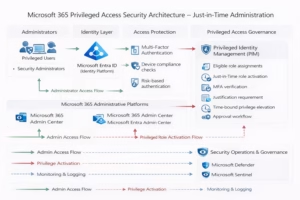
Privileged Identity Management in SC-900 explains why standing administrative access is a security risk and how organisations control privileged roles using time-bound, just-in-time access. In many environments, users are granted permanent admin roles “just in case.” Over time, this creates standing privilege, one of the biggest contributors to security breaches. That’s why Privileged Identity Management ...
Read the full article Identity Lifecycle & Access Reviews in SC-900: Managing Access from Joiner to Leaver
Identity Lifecycle & Access Reviews in SC-900 explain how organisations manage access as users join, change roles, and leave. Access control is not a one-time decision. Users move between roles, take on temporary responsibilities, and eventually exit the organisation, making lifecycle-based access management critical for security and compliance. Users join organisations, change roles, take on ...
Read the full article Role-Based Access Control (RBAC) in SC-900: How Access Is Structured Securely
One of the biggest security risks in any organisation is unclear access. When users have permissions based on convenience instead of responsibility, security quickly becomes difficult to manage, audit, and trust. This is why Role-Based Access Control (RBAC) is a core concept in SC-900 (Microsoft Security, Compliance, and Identity Fundamentals). Understanding RBAC in SC-900 is ...
Read the full article Identity Types in SC-900: Users, Devices, Applications, and Workloads Explained Clearly
When most people hear the word identity, they think of a user account.In modern cloud security, that understanding is incomplete. In SC-900 (Microsoft Security, Compliance, and Identity Fundamentals), Microsoft makes one thing very clear: Security is not only about users — it’s about all types of identities. This includes users, devices, applications, and workloads.Understanding these ...
Read the full article Microsoft Entra ID Overview in SC-900: Understanding Microsoft’s Identity Platform
Microsoft Entra ID Overview in SC-900 Modern security starts with identity. In cloud and hybrid environments, networks are no longer the primary boundary. Users access applications from anywhere, on multiple devices, using cloud services that sit outside traditional perimeters. This is why Microsoft Entra ID is a core topic in SC-900 (Microsoft Security, Compliance, and ...
Read the full article