How to Choose the Right IT Certification: 7 Practical Steps for Your Career
How to choose the right IT certification is a common question for beginners entering the IT field.
Understanding how to choose the proper IT certification helps you avoid wasting time and money on paths that don’t align with your career goals.
With so many options across cloud, security, networking, and system administration, it’s easy to feel overwhelmed or choose the wrong certification. Knowing how to select the proper IT certification early helps you build a focused learning path instead of following random trends.
This article explains how to choose the right IT certification in a practical way, so beginners can make confident, career-aligned decisions.
To understand the learning philosophy behind this site, visit the About TechCertGuide.
Why Choosing the Right Certification Matters
IT certifications are not just exams; they represent a learning path. Choosing the wrong certification can lead to frustration, failed exams, or knowledge that doesn’t align with your career goals.
The right certification helps you:
- Learn relevant skills
- Build confidence
- Improve job readiness
- Create a clear career direction
The key is alignment, not popularity.
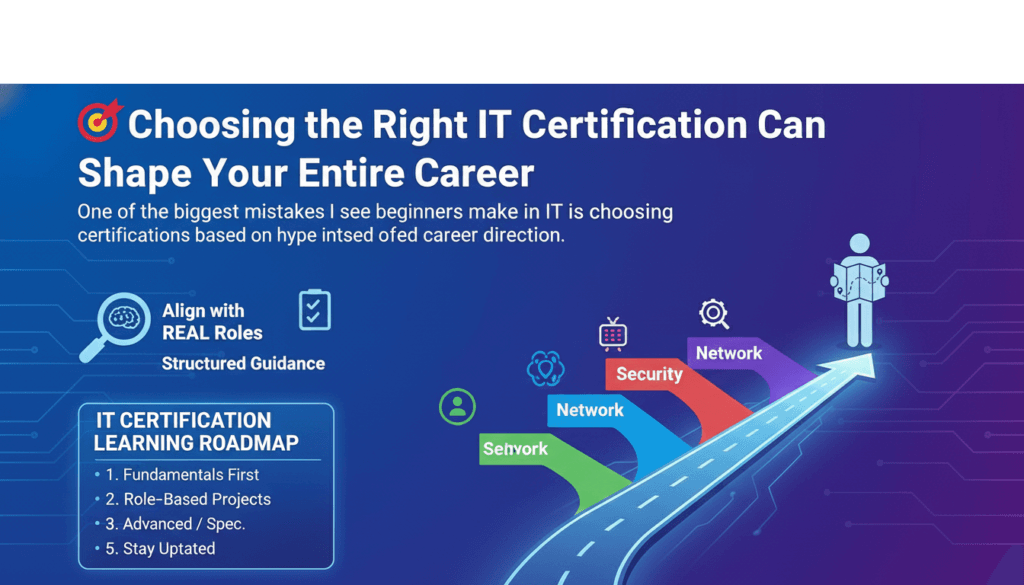
Step 1: Understand Your Career Goal First
Before selecting any certification, ask yourself one simple question:
What kind of IT role do I want to move toward?
Some common IT career directions include:
- IT Support / System Administration
- Cloud Computing
- Cybersecurity
- Networking
- Identity & Access Management
- Governance, Risk, and Compliance (GRC)
Learning how to choose the proper IT certification starts with understanding your career goals and current experience level.
You don’t need to decide your entire career today, but having a starting direction is important.
Step 2: Match Certifications to IT Career Paths
Different certifications serve different roles. Below is a simple way to match certifications with career interests.
IT Support & System Administration
If you enjoy:
- Working with operating systems
- Managing users and devices
- Troubleshooting systems
- Supporting end users
Start with certifications that focus on:
- IT fundamentals
- Operating systems
- Identity basics
- Endpoint management concepts
These roles build a strong foundation and are ideal for beginners.
Cloud Computing
If you’re interested in:
- Cloud platforms
- Virtual machines and services
- Scalability and availability
- Modern infrastructure
Start with:
- Cloud fundamentals certifications
- General cloud concepts
- Platform-neutral cloud knowledge
Avoid jumping directly into advanced cloud architect certifications early.
Cybersecurity
If you’re curious about:
- Protecting systems and data
- Security concepts and threats
- Compliance and risk management
Begin with:
- Security fundamentals
- Identity and access concepts
- Compliance basics
Cybersecurity requires strong fundamentals—starting slow is the smart path.
Networking
If you like:
- How devices communicate
- Network design and troubleshooting
- IP addressing and protocols
Look for certifications covering:
- Networking fundamentals
- Routing and switching basics
- Network security concepts
Networking knowledge also helps in cloud and security careers.
Step 3: Beginner vs Role-Based Certifications
One of the most common mistakes beginners make is choosing role-based certifications too early.
Beginner / Fundamentals Certifications
These are ideal if:
- You’re new to IT
- You want conceptual understanding
- You’re exploring career options
They focus on:
- Terminology
- Core concepts
- Real-world usage at a high level
Role-Based Certifications
These are better if:
- You already understand fundamentals
- You have hands-on experience
- You’re targeting a specific job role
Role-based certifications assume prior knowledge.
Start small, then specialize.
Step 4: Consider Your Background (Very Important)
Your past experience matters when choosing a certification.
If you are a student or fresher:
- Start with fundamentals
- Focus on learning, not job titles
- Avoid advanced exams
If you are switching careers:
- Choose certifications with conceptual clarity
- Link learning to real-world use cases
- Don’t rush into specialization
If you already work in IT:
- Pick certifications aligned with your current role
- Strengthen weak areas (cloud, security, identity)
Step 5: Certifications Are Not About Speed
Many beginners ask:
“How fast can I complete this certification?”
A better question is:
“How well will I understand this certification?”
Rushing certifications leads to:
- Knowledge gaps
- Poor interview performance
- Low confidence
Take time to:
- Understand concepts
- Practice basics
- Build confidence
Step 6: Build a Simple Certification Roadmap
Here’s a simple example roadmap:
- IT or Cloud fundamentals
- Security or identity basics
- Choose a specialization
- Move to role-based certifications
- Gain hands-on experience
This approach keeps learning structured and sustainable.
Step 7: Avoid These Common Mistakes
Beginners often struggle because of these mistakes:
- Choosing certifications based on hype
- Studying multiple certifications at once
- Ignoring hands-on learning
- Expecting certifications to guarantee jobs
Certifications are tools—not shortcuts.
Step 8: Certifications vs Skills – The Right Balance
Certifications validate learning, but skills prove capability.
Employers look for:
- Understanding of concepts
- Ability to learn
- Practical problem-solving
Use certifications as:
- A learning framework
- A confidence booster
- A resume enhancer
Combine them with practice for best results.
Official platforms such as Microsoft Learn provide structured, role-aligned certification learning paths for beginners and professionals.
Final Thoughts
Choosing the right IT certification is about clarity, not competition. There is no single “best” certification for everyone—only the one that aligns with your goals and experience.
Start with fundamentals, understand your interests, and grow step by step. Over time, the right certifications combined with hands-on skills can help you build a strong and sustainable IT career.
If you are new to IT, you may also find our guide on how to start a career in IT certifications helpful.
2 thoughts on “How to Choose the Right IT Certification Based on Your Career”